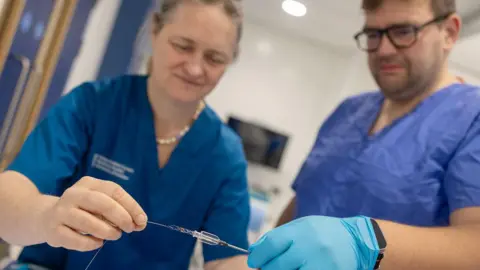
Doctors from Scotland and the United States have successfully completed what is believed to be a historic brain operation using automated systems.
The medical expert, associated with a Scottish university, conducted the distant clot removal - the removal of circulatory obstructions after a stroke - on a medical specimen that had been donated to medical science.
The professor was located at a treatment center in the location, while the body she was operating on with the device was across the city at the academic institution.
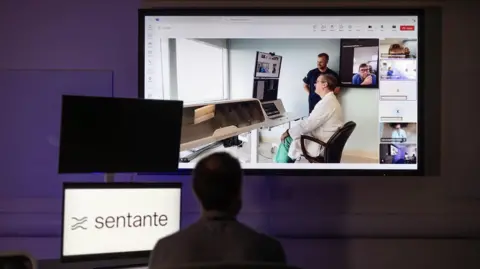
Subsequently, a neurosurgeon from the American state used the technology to conduct the first transatlantic surgery from his American facility on a medical specimen in Dundee over significant distance away.
The team has described it as a potential "game changer" if it receives authorization for clinical application.
The doctors believe this system could revolutionize stroke treatment, as a limited availability of expert care can have a significant effect on the chances of recovery.
"It seemed like we were seeing the initial vision of the next generation," commented the medical expert.
"Where previously this was thought to be science fiction, we proved that each phase of the procedure can already be done."
The Scottish institution is the global training center of the global medical association, and is the exclusive site in the United Kingdom where doctors can treat donated bodies with actual blood pumped through the arteries to simulate procedures on a live human.
"This was the first time that we could conduct the entire surgical process in a actual human specimen to demonstrate that all steps of the surgery are achievable," explained the lead expert.
Juliet Bouverie, the head of a medical organization, called the long-distance operation as "a remarkable innovation".
"During many years, individuals from remote and rural areas have been limited in obtaining to clot removal," she continued.
"Robotics like this could address the disparity which persists in stroke treatment across the UK."
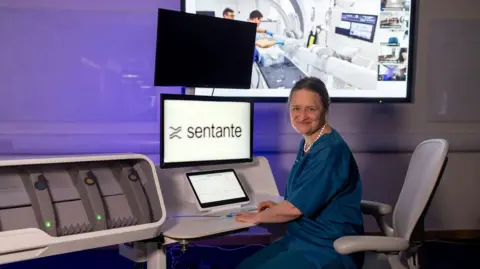
How does the technology work?
An blockage stroke happens when an artery is blocked by a blockage.
This disrupts vascular flow to the cerebral tissue, and neurons stop functioning and expire.
The superior intervention is a thrombectomy, where a surgeon uses medical instruments to remove the clot.
But what transpires when a individual cannot access a specialist who can perform the surgery?
The medical expert explained the study showed a automated system could be attached to the equivalent surgical tools a specialist would conventionally utilize, and a medic who is with the patient could readily join the tools.
The specialist, in another location, could then operate and direct their own wires, and the robot then executes exactly the same movements in immediate sequence on the individual to conduct the thrombectomy.
The subject would be in a treatment center, while the doctor could perform the operation using the automated equipment from any place - even their personal residence.
Prof Grunwald and the neurosurgeon could see live X-rays of the specimen in the experiments, and track developments in real time, with the Scottish specialist saying it took merely twenty minutes of preparation.
Major corporations Nvidia and Ericsson were involved in the initiative to secure the connectivity of the mechanical device.
"To operate from the United States to Scotland with a 120 millisecond lag - a moment - is truly remarkable," stated Dr Hanel.
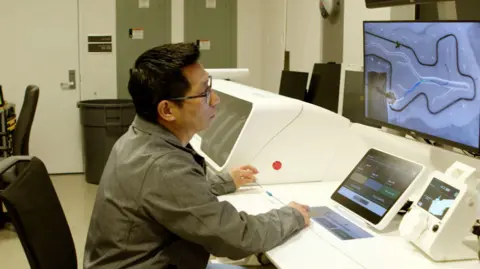
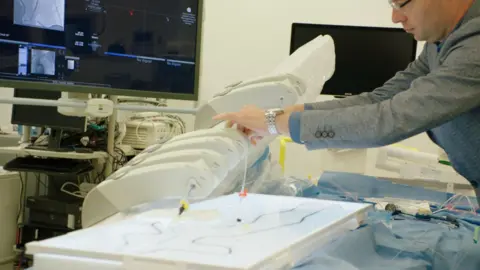
Innovations in cerebral healthcare
The lead researcher, who has won an award for her research and is also the vice president of the international medical organization, stated there were key issues with a traditional procedure - a international lack of surgeons who can perform it, and intervention relies upon your geographical position.
In the Scottish nation, there are only three places individuals can receive the procedure - Dundee, Glasgow and Edinburgh. If you don't live there, you must journey.
"The treatment is extremely time-critical," explained the medical expert.
"For every six minutes of waiting, you have a slightly decreased likelihood of having a successful recovery.
"This technology would now deliver a novel approach where you're not depending on where you live - saving the valuable minutes where your cerebral matter is degenerating."
Medical statistics showed there were {9,625 ischaemic strokes|numerous cerebral events|


